 English
 русский
 عربى
 Español

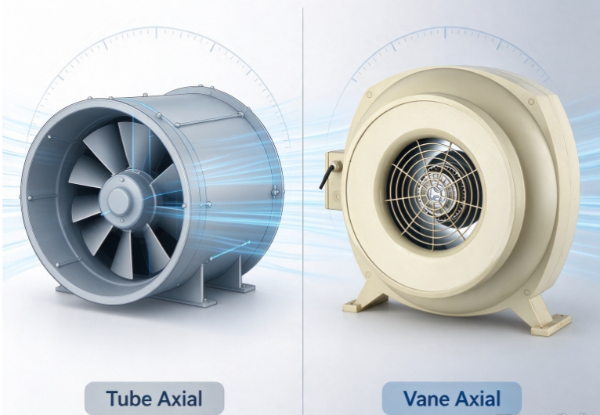
Tube axial and vane axial fans are two common designs in ventilation systems. Both push air along the fan's axis. They differ in how air passes through the housing and how the surrounding parts guide it. Those differences can affect airflow behavior, installation requirements, operating conditions, and maintenance.
Knowing the distinction helps engineers, facility managers, and buyers choose well. The choice depends on the ventilation system, not on how the fan looks. A closer look at their structures and uses shows why each design earns its place in industrial air movement.
What Is a Tube Axial Fan?
A tube axial fan is an axial fan mounted inside a cylindrical housing. Its blades turn around a central shaft and push air in the direction of that shaft. The housing surrounds the assembly and guides the air along the ventilation path.
The design is fairly simple. Air enters one side, passes through the spinning blades, and leaves the other side. The cylindrical casing gives the airflow a defined passage, so the fan suits ductwork or openings where air has to move between connected spaces.
You'll often see tube axial fans in industrial ventilation, equipment cooling, exhaust systems, and general air circulation. They can pull heat away from machinery, carry unwanted air out of a work area, or feed fresh air into enclosed spaces.
Part of their appeal is that simple layout. The housing connects to a duct system, so the fan can become part of a larger ventilation network. That helps in factories, workshops, storage facilities, and other buildings where air must follow a planned route.
A tube axial fan doesn't fit every duct arrangement, though. Resistance rises when a system has restrictive passages, sharp turns, filters, dampers, or other components. The fan has to operate within conditions that match what it can do. A design that works well in a fairly open path may behave differently in a more demanding network.
Installation shape matters too. The space around the inlet and outlet, the condition of nearby duct sections, and any obstacles all affect the air entering and leaving the fan. Weigh these alongside the basic design.
What Is a Vane Axial Fan?
A vane axial fan uses a similar rotating blade setup but adds stationary guide vanes in the airflow path. These vanes are placed to shape the direction of the air as it moves through the fan.
When air passes through rotating blades, it can leave with a swirling motion. The stationary vanes redirect that flow and cut down the unwanted rotation. This changes how air moves through the system and can improve the fan's ability to work under certain pressure conditions.
The guide vanes are what set a vane axial fan apart from a basic tube axial design. They don't spin with the main blades. They stay fixed and steer the moving air.
Designers often consider vane axial fans for systems where air must travel through ductwork with meaningful resistance. They may serve industrial exhaust, large building ventilation, and other installations where the airflow path needs careful management.
Their internal arrangement is more involved than a basic tube axial fan's. The extra components affect the fan's physical design, maintenance needs, and operating characteristics. How much they matter depends on the construction and the operating conditions.
Don't assume a vane axial fan suits every high-resistance system. Performance still depends on how the fan relates to the connected ductwork. Choosing well means understanding the whole ventilation arrangement, not just noting that guide vanes are present.
How Do Tube Axial and Vane Axial Fans Differ in Structure?
The most visible difference sits inside the housing. Both use rotating blades to move air along the axis, but vane axial fans add stationary parts that influence the airflow after it leaves the rotating section.
A tube axial fan generally has a simpler interior. Its main parts are the housing, motor, shaft, and rotating blades. Depending on the model, it may also have supports and protective components.
A vane axial fan has those same elements plus guide vanes. Their position and shape are designed to control the direction of the moving air, so the internal airflow path is more carefully managed.
This structural difference affects several practical points.
| Design aspect | Tube axial fan | Vane axial fan |
|---|---|---|
| Internal arrangement | Relatively simple airflow passage | Includes stationary guide vanes |
| Airflow direction | Air follows the path created by the rotating blades and housing | Guide vanes help redirect airflow after the rotating section |
| Main design consideration | Matching the fan to the ventilation path | Matching both the fan and guide vane arrangement to system conditions |
| Installation needs | Depends on the housing, duct layout, and access requirements | Also requires consideration of the internal guide vane assembly |
| Maintenance focus | Blades, motor, housing, and mounting components | Blades, motor, housing, guide vanes, and mounting components |
| Typical application considerations | General ventilation and relatively straightforward air movement | Ventilation systems where control of airflow direction and pressure behavior is important |
These points give you a starting place, not a universal ranking. Two fans of the same type can perform differently because of blade design, motor arrangement, housing geometry, and intended operating conditions.
The surrounding ventilation network matters just as much. Evaluate a fan as part of the system where it will run.
How Does Airflow Behavior Affect Fan Selection?
Airflow is about more than volume. Its direction, stability, and interaction with nearby surfaces also count. A fan's internal design influences these traits, while the connected system decides how the air can actually move.
In a tube axial fan, the rotating blades pass energy to the air. Some rotational movement may remain in the air that leaves the fan. How much depends on the blade design and operating conditions.
In a vane axial fan, stationary guide vanes redirect the air and reduce its rotation. Under suitable conditions, that can improve how well the fan uses the energy the motor supplies. It can help when the system asks the fan to overcome greater resistance.
A real layout makes this clearer. Picture a fan pushing air through a long duct with several bends and other components. Each one resists the flow and raises the pressure the fan must provide.
If you pick a fan without accounting for those restrictions, it may not deliver the airflow the building needs. Rooms can get too little ventilation, exhaust air can move slowly, and the system can burn energy without reaching its goal.
Guide vanes can help in the right applications, but they can't remove every source of resistance. Poor duct design, blocked filters, unsuitable transitions, and badly placed openings can still choke the flow.
Intended use plays a part as well. A system built for general circulation has different needs from one that extracts warm air from enclosed machinery or carries exhaust through a complicated duct network.
Engineers should look at the expected airflow, the resistance of the connected system, the available space, and the operating pattern. Those factors show whether a tube axial or vane axial design fits.
Where Are Tube Axial and Vane Axial Fans Commonly Used?
Both designs appear in industrial and commercial settings, but suitability depends on each application's demands.
Tube axial fans are common where a direct airflow path is practical. You can install them in wall openings, ventilation ducts, equipment enclosures, and exhaust arrangements. Their simple structure suits spaces where the ventilation route doesn't add excessive resistance.
In manufacturing, they may remove warm air from equipment or keep air circulating around work areas. In storage buildings, they can exchange indoor and outdoor air. They also show up in cooling arrangements for machinery and electrical equipment.
Vane axial fans come into play when the system makes bigger demands on pressure and airflow management. Their guide vanes help control the direction of air leaving the rotating blades, which can benefit certain ducted ventilation applications.
You may find them in industrial exhaust networks, building ventilation systems, and installations where air must pass through a more restrictive route. Whether a particular fan fits depends on actual system requirements and the manufacturer's performance data.
| Application scenario | Questions to consider |
|---|---|
| Open industrial ventilation | Is the airflow path relatively direct, and is the required ventilation straightforward? |
| Ducted exhaust | How much resistance comes from the duct length, bends, and connected equipment? |
| Machinery cooling | Does the fan provide the airflow needed to remove heat from the equipment? |
| Commercial building ventilation | How do the duct layout, occupancy needs, and operating schedule affect fan selection? |
| Restricted installation spaces | Is there enough room for the fan, its connections, and routine maintenance? |
| Continuous operation | How will operating conditions, energy use, and maintenance access affect the installation? |
These examples aren't hard boundaries. A tube axial fan may work in some ducted systems, and a vane axial fan may be overkill for a simple ventilation job. Let the application's needs drive the decision.
Can Energy Use and Maintenance Change the Decision?
Energy use matters when a fan runs for long hours. Fan type alone can't tell you how much electricity the system will draw.
The motor, blades, operating point, and the resistance of the ventilation network all affect consumption. A fan running far from its intended conditions can waste energy without delivering the airflow you need. A well-matched design helps the system meet ventilation needs without unnecessary load.
Guide vanes can improve a vane axial fan's aerodynamic behavior under the right conditions. That doesn't mean every vane axial fan uses less energy than every tube axial fan. Compare the actual performance of the models you're considering at the airflow and pressure you need.
Maintenance adds another practical difference. Tube axial fans have a fairly simple interior, though blades, motor, bearings, supports, and housing still need inspection per the manufacturer's guidance.
Vane axial fans also need attention to the guide vanes. Dust buildup, physical damage, or changes in their condition can alter the airflow path. Plan for access to these parts when you plan the installation.
Routine maintenance should cover checks for unusual vibration, unexpected noise, loose mounting hardware, damaged components, and airflow changes. The right schedule depends on the operating environment and the manufacturer's recommendations.
A fan in a dusty production area faces different maintenance demands from one in a clean commercial building. Moisture, airborne particles, corrosive substances, and continuous operation can all affect component condition.
So treat maintenance access as part of fan selection, not something to think about after installation. A design that's hard to inspect or service can cause avoidable disruption during routine work.
What Should You Check Before Choosing a Fan?
Choosing between tube axial and vane axial fans starts with the ventilation requirement. The goal is a design that can deliver the required airflow under the conditions the system will face.
A few practical questions can guide you.
What airflow does the application require?
The fan must move enough air for its purpose. A cooling system, an exhaust installation, and a general ventilation network may each need something different. Establish the expected airflow before you compare equipment.
How much resistance will the system create?
Duct length, bends, filters, dampers, grilles, and connected equipment all add resistance. A fan chosen without counting these may not perform as expected.
How much installation space is available?
The housing must fit the location, and the installation should leave room for safe access, electrical connections, and routine service. The size and layout of connected ducts matter too.
What operating conditions will the fan face?
Temperature, moisture, dust, and the nature of the air being moved affect material choice and maintenance needs. Industrial environments may call for construction features that other settings don't.
How will the fan be maintained?
Think about inspection access, component replacement, and cleaning before installation. The arrangement should support the maintenance needed to keep the ventilation system working.
What performance information is available?
Manufacturer documentation lets buyers compare airflow and pressure characteristics, energy needs, sound behavior, and installation conditions. These details are a more reliable basis for selection than the fan category alone.
A careful evaluation can also show whether changes to the duct layout would help. Cutting unnecessary bends, improving transitions, or removing restrictions may improve the whole arrangement without switching fan designs.
The relationship between fan and system is central to the decision. Tube axial fans offer a fairly straightforward approach to axial air movement, while vane axial fans add components that guide the airflow and may support operation in more demanding conditions. Understanding these differences helps buyers and engineers judge which design fits the actual ventilation task.