 English
 русский
 عربى
عربى Español
Qinlang focuses on providing high-quality products and considerate services, and is committed to meeting every expectation of our customers.
The DKT-133 Cooling Ventilation Double Inlet Air Conditioning Fan is d...
See Details
In modern ventilation planning, understanding how Vane Axial Fan And Tube Axial Fan behave inside different airflow environments can help engineers, designers, and facility owners make more practical decisions. These two fan structures are often discussed together because they share a similar axial airflow direction, but their internal airflow control approach and installation behavior can lead to noticeably different results in real systems.
Instead of thinking in terms of which one is better or stronger, it is more useful to focus on where each type fits naturally, how air moves through each design, and what kind of system layout they respond to more smoothly. This is especially important in large buildings, tunnels, workshops, and HVAC networks where airflow stability and pressure balance matter more than appearance or size.
Understanding the basic idea behind both airflow systems
Both fan types move air along a straight path, parallel to the shaft. That simple principle is shared. However, the way air is guided after entering the rotor area is where the behavior starts to diverge.
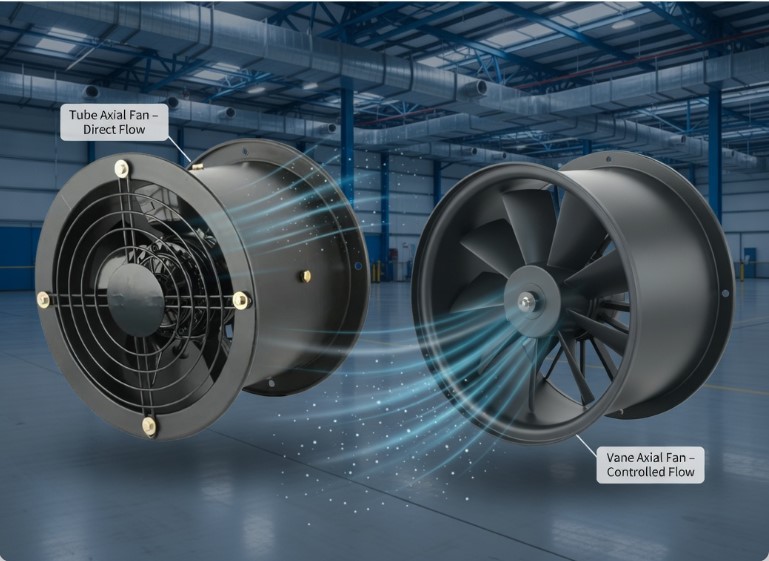
A tube axial unit usually focuses on pushing air directly through a cylindrical housing. The airflow tends to remain straightforward with minimal directional correction inside the casing.
A vane axial unit includes internal guide elements that help smooth and organize airflow after it passes the impeller. This can reduce swirl and help stabilize pressure distribution in more structured duct systems.
This difference may seem subtle at first, but in real engineering environments, it can influence noise behavior, airflow consistency, and how well the system matches long duct runs or complex layouts.
Where airflow efficiency starts to change in real applications
Airflow efficiency is not only about moving air quickly. It is about how air behaves across distance, bends, and resistance points.
In simple ventilation paths, both systems may perform in a similar way. But once duct length increases or airflow encounters structural resistance, their behavior begins to separate.
A tube axial setup often works well in open or semi-open environments where air does not face many directional changes. It keeps the movement straightforward and is easier to integrate into simpler systems.
A vane axial setup becomes more noticeable in structured systems where airflow needs more controlled direction after passing through the fan section. The internal guidance helps reduce chaotic movement of air particles, which can support more stable distribution through connected ducts.
Installation environment plays a major role
One of the most important aspects of choosing between these two systems is the installation environment. Many performance differences are not caused by the fan itself, but by how it interacts with surrounding structures.
Common environments for tube axial setups
In these cases, airflow does not need heavy correction after leaving the fan. The system design is more direct, and installation tends to be more flexible.
Common environments for vane axial setups
Here, airflow stability becomes more important than raw movement. The internal guidance structure helps maintain more consistent flow behavior across distance.
Airflow behavior differences in practical terms
Instead of focusing on technical definitions, it is easier to understand differences through real-world behavior.
A tube axial system often produces a more direct air stream. This can feel more immediate in open air movement, but in longer duct systems, airflow may lose uniformity over distance.
A vane axial system tends to smooth airflow patterns after the impeller stage. This can help reduce uneven air movement inside ducts and improve distribution consistency in structured environments.
Neither approach eliminates resistance or system loss completely. Instead, each one interacts differently with system layout and airflow direction changes.
Noise perception and system balance
Noise behavior is another factor that often comes up in ventilation planning discussions.
Tube axial designs may produce more noticeable airflow turbulence in certain setups, especially when duct resistance increases or when airflow meets sudden direction changes.
Vane axial designs, due to internal guiding structures, can help reduce airflow swirl inside the housing. This can lead to a more controlled acoustic environment in systems where sound management is part of the planning requirement.
It is important to note that noise performance is not only about fan design. Installation quality, duct sealing, and system alignment all contribute significantly.
Simple comparison for system planning
| Aspect | Tube Axial Fan | Vane Axial Fan |
|---|---|---|
| Airflow direction | Straight movement | Guided and stabilized movement |
| System layout fit | Simple layouts | Structured duct networks |
| Airflow behavior | Direct discharge | Smoothed distribution |
| Installation style | Flexible | More system-oriented |
| Acoustic behavior | Depends on resistance | More controlled in ducts |
| Common use case | Open ventilation spaces | Complex airflow systems |
Where engineers usually notice performance differences
In real project environments, differences are usually observed in three main situations:
1. Long distance airflow transfer
When air needs to travel through extended duct systems, stability becomes more important than initial movement force. The vane-guided structure tends to help maintain flow consistency.
2. Multiple branch distribution systems
In systems where airflow splits into several directions, maintaining balanced distribution becomes important. The structured airflow from vane-type systems can help support this requirement.
3. Simple ventilation discharge setups
When airflow is mainly used for extraction or intake without long duct travel, tube-style systems are often easier to integrate and maintain.
System design considerations before selection
Before choosing between the two, it is helpful to evaluate the full system rather than focusing only on the fan unit.
Key questions to consider
These questions often matter more than the fan type itself. In many real installations, performance differences appear because the system design and fan type are not matched properly.
Maintenance perspective in real environments
Maintenance is often overlooked during initial planning, but it plays a long-term role in airflow stability.
Tube axial systems usually have a simpler internal structure, which can make inspection and cleaning more straightforward in basic setups.
Vane axial systems may require more attention to internal airflow guidance elements, especially in environments where dust or particles are present.
However, both systems benefit from regular inspection of duct connections, alignment, and airflow obstruction conditions.
Energy behavior in system planning
Instead of focusing on extreme claims, it is more realistic to understand energy behavior as a system balance issue.
Tube axial systems often perform well in straightforward airflow routes where resistance is low.
Vane axial systems can support more controlled airflow distribution in structured networks, which may help reduce unnecessary airflow disturbance inside ducts.
The actual energy usage depends heavily on system design, duct configuration, and operational conditions rather than fan type alone.
Choosing based on application logic
A practical way to decide is not by comparing labels, but by matching airflow behavior to project needs.
If the system is simple, direct, and short in layout, tube axial configurations often integrate smoothly.
If the system involves structured airflow pathways, longer ducts, or controlled distribution, vane axial configurations may align better with system expectations.
This approach avoids overcomplication and focuses on how air actually behaves in the environment.
Common misunderstandings in airflow planning
One common misunderstanding is assuming that one design automatically performs better in all conditions. In reality, airflow systems are highly dependent on surrounding structure.
Another misunderstanding is focusing only on airflow movement without considering resistance, duct shape, and system balance.
In practice, the interaction between fan design and system layout defines overall performance more than any single component.
Practical installation insights
During installation planning, a few simple considerations can improve system performance regardless of fan type:
These small adjustments often influence airflow behavior more than equipment selection alone.
Real-world usage scenarios
In industrial buildings, tube axial systems are often seen in open ventilation or short exhaust lines where airflow needs to be moved without complex distribution.
In infrastructure environments such as tunnels or enclosed passages, vane axial systems are more commonly integrated due to their structured airflow behavior across longer distances.
In HVAC planning, both types may appear within the same system depending on zone requirements.
When evaluating Vane Axial Fan And Tube Axial Fan, it becomes clear that the main difference is not about strength or performance labels, but about how each system interacts with airflow structure.
One design focuses on direct movement, while the other focuses on guiding airflow more smoothly within a structured path. Both serve important roles depending on how the ventilation network is built.
In real engineering work, the most reliable results often come from matching airflow behavior to system design rather than trying to force one solution into all environments.
Understanding this relationship helps create more stable ventilation setups that respond naturally to their operating conditions without unnecessary complexity.
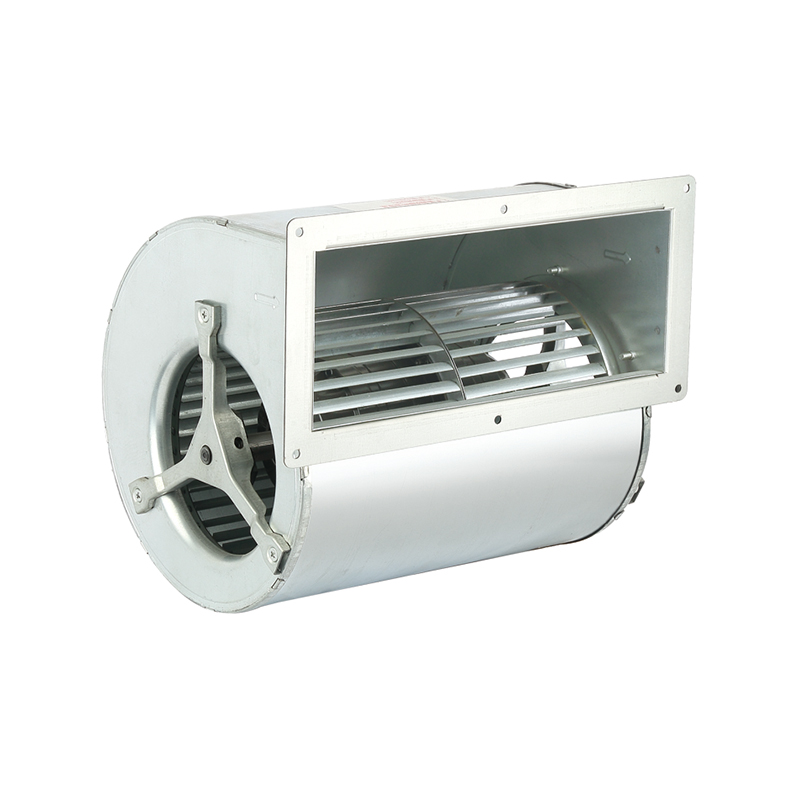
The DKT-133 Cooling Ventilation Double Inlet Air Conditioning Fan is d...
See Details
The DKT-146 Multi-Function Variable Frequency Double Inlet Air Conditi...
See Details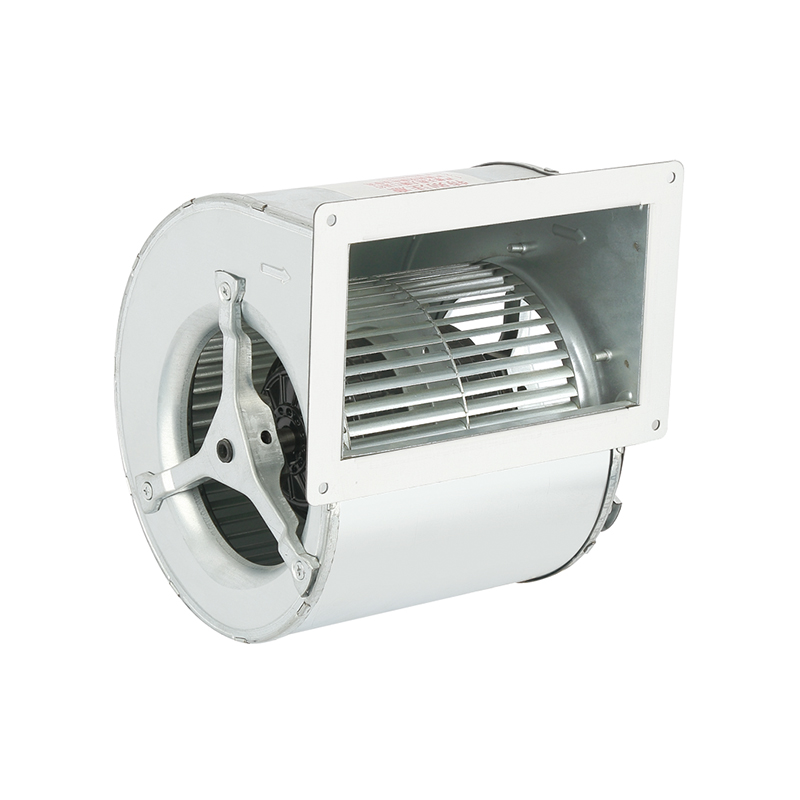
The DKT-160 Heat Dissipation Exhaust Double Inlet Air Conditioning Fan...
See Details
The DKT-180 Tilt Back Cool Down Double Inlet Air Conditioning Fan, a s...
See Details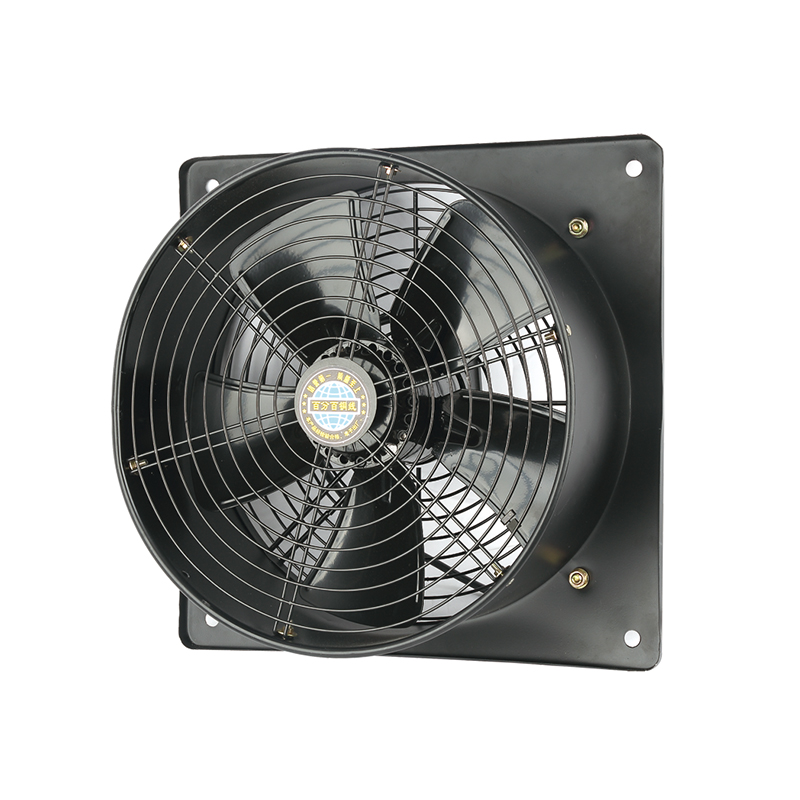
The YWF-400-2D2E Efficient Square form Axial fan is designed with a fo...
See Details
The YWF-350-2D2E Low noise Square form Axial Fan is designed with a co...
See Details
The YWF-350-4D4E Low vibration Square form Axial Fan is a outstanding ...
See Details
The YWF-400-4D4E Durable Square form Axial Fan is designed with advanc...
See Details
Qinlang focuses on providing high-quality products and considerate services, and is committed to meeting every expectation of our customers.
© Zhejiang Qinlang Electromechanical Co., Ltd.
Fans And Air-Cooling Equipment Factory
